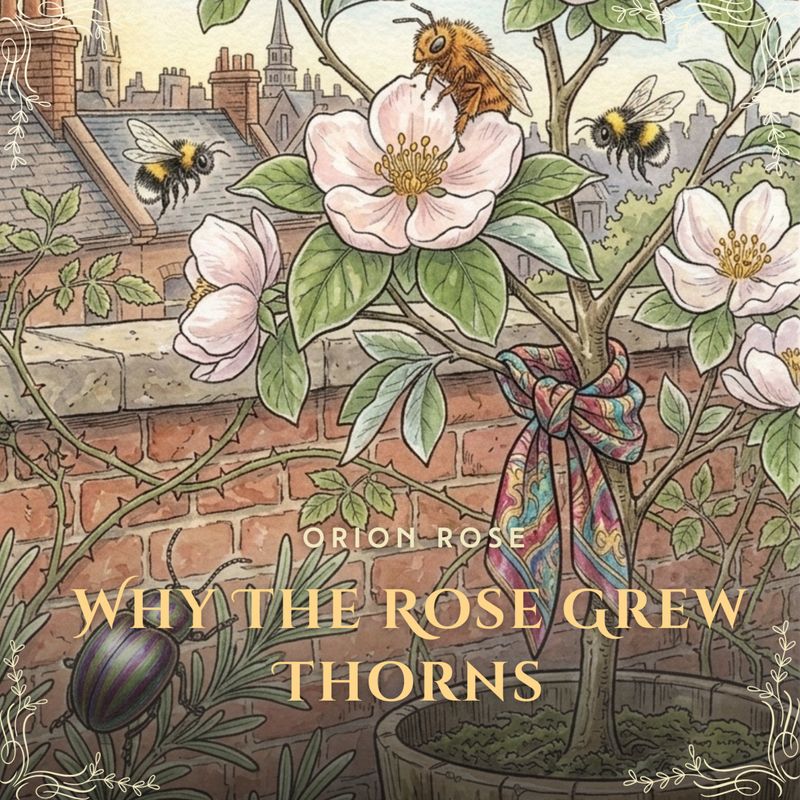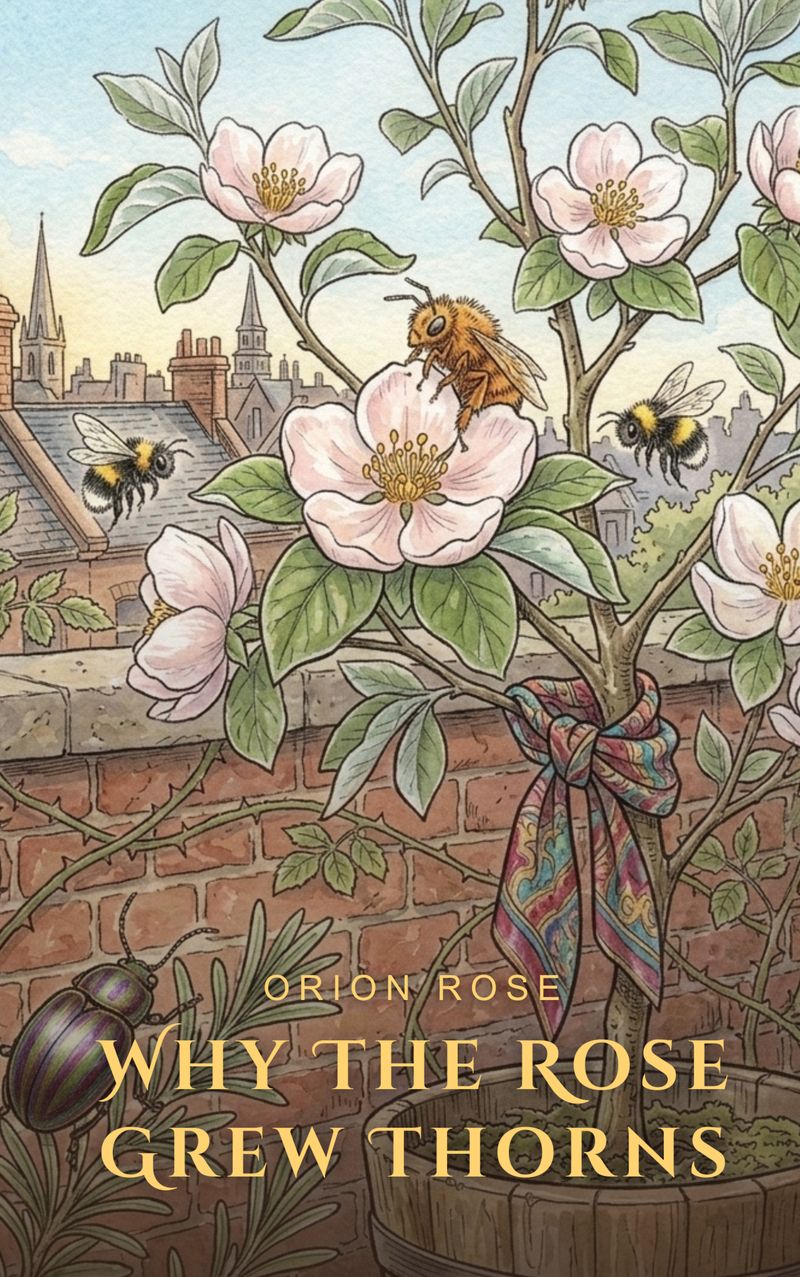
Why the Rose Grew Thorns: a fairy tale for grown-ups
High above London, a jewelled beetle overhears a Queen's secret and a wounded prince longs to be loved. Meet the first of Orion Rose's Garden Tales.
Published
Some stories begin with a door. This one begins with a rosemary bush. Five floors above a London street, among the slate roofs and old brick walls, a roof garden keeps its own kingdoms, its own manners and a great deal of gossip. The city below hurries about its business and never looks up. The swifts know the garden is there, and the pigeons, and the bees, who know everything worth knowing. In Why the Rose Grew Thorns, the first of the Garden Tales by Orion Rose, readers are let in on the secret too.
Our guide is Chrysolina, a rosemary beetle striped from head to tail in emerald and violet, like a brooch someone dropped and forgot to pick up. The bees call him the Brooch, on the reasonable grounds that a brooch that looks like a brooch is a brooch, even if it has legs. He is a botanist who has eaten his way to wisdom, and he cannot be fooled. When the silver Curry Plant greets the rosemary as its cousin, Chrysolina knows better. Shape, he explains to a shivering young bumblebee, is a costume. Family has a flavour. Lavender, it turns out, is a mint, and the garden is full of disguises.
On the other side of the wall grows the Queen, an ancient and magnificent Rose whose perfume rolls over the bricks each June like a velvet curtain at the end of an opera. She is the loveliest thing in the garden, and she bristles with thorns. The goldfinches say thorns are for keeping deer and rabbits away, and that is true as far as it goes. One summer evening, hidden in the topmost sprig of rosemary, Chrysolina hears the rest of the truth, the oldest secret in the garden, told by the Queen herself.
It is a mother's story. Long ago the Queen had two children, Strawberry, who loved the warm ground, and Apple, who reached for the sky, and each begged her to say which of them she loved best. She tried and tried to decide, and the strain of it made her bristle until thorns grew all along her stems. Her children left to found kingdoms of their own, a low green one stitched together with runners and an orchard on the hillsides, and the wounded Queen decreed that none of them should ever wear her perfume. They obeyed. Almost. Apple carried away one single drop, folded so deep inside his own scent that only a mother could ever find it.
Which brings us to Quince. Born in the orchard kingdom long after the quarrel, he is a prince of the House of the Rose who has never once seen the Queen's face, and he longs for her all the same. He arrives in the garden hurt, a branch broken on a long journey, and the gentle Gardener wraps the break in his very finest silks. It is one of the loveliest moments in the book, and it comes with one of its best lines: 'So the prince got well out of sheer good manners, since anything less would have been rude to the silk.'
Quince is a romantic and a dandy, with great pale pink blossoms and velvety leaves, and he turns every one of his blossoms towards the wall, the way you might turn your face towards a window where a light is burning. When his love goes unanswered, he draws a soft grey coat of down over every one of his young fruits. 'It is a veil,' he says. 'If the Queen does not love me, then I will not be shown to anyone else.' His fruit grows hard and sour, the bitterness of a love that was never returned, and the goldfinches and bumblebees, who wear fur coats of their own, do their best to comfort him.
Then the story turns, softly, on a secret. Kept close, with a little magic and a great deal of patience, Quince's bitter fruit changes and blushes rose pink. Only the Gardener knows, and one small beetle listening in the rosemary. It happens in the Gardener's kitchen, by a quiet magic nobody is meant to see, and the Queen must never find out, because it goes against her decree. Of course, in a garden full of goldfinches, a secret is only ever one whisper away from becoming a song.
That is why this is a fairy tale for grown-ups. Its subjects are the ones we carry into adult life: a parent who could not choose, children who went away, the ache of longing to belong to a family that has turned aside, and the comfort of being cared for by someone who asks for nothing in return. The book wears all of this lightly. There are jokes about bees and botany, a murmuring court led by the gentle Lord Rosewood, a Magnolia in the far corner whose perfume is light and sweet at first and then strangely heavy, and a beetle who loves a secret almost as much as he loves rosemary. Underneath it all runs a real tenderness about friendship, longing and the small, steady kindnesses that heal.
It is full of true natural history, too, folded in as gracefully as Apple's drop of scent: how some plants are cousins by climate and others by blood, why lavender belongs with the mints, how a rose and an apple can share a family resemblance. You finish the book seeing your own garden, or the window box on the ledge, a little differently. Every plant suddenly seems to be keeping a story to itself.
Above it all, on certain evenings, a single star comes out over the chimney pots. Nobody can say which one, and nobody on the terrace would think to ask. It is the kind of detail that makes you want to look up. The audiobook, read by Leonora Flint, is a lovely way to spend an evening in the garden's company. However you meet it, begin as Chrysolina does: very still, very quiet, listening at the wall.
Books in this story